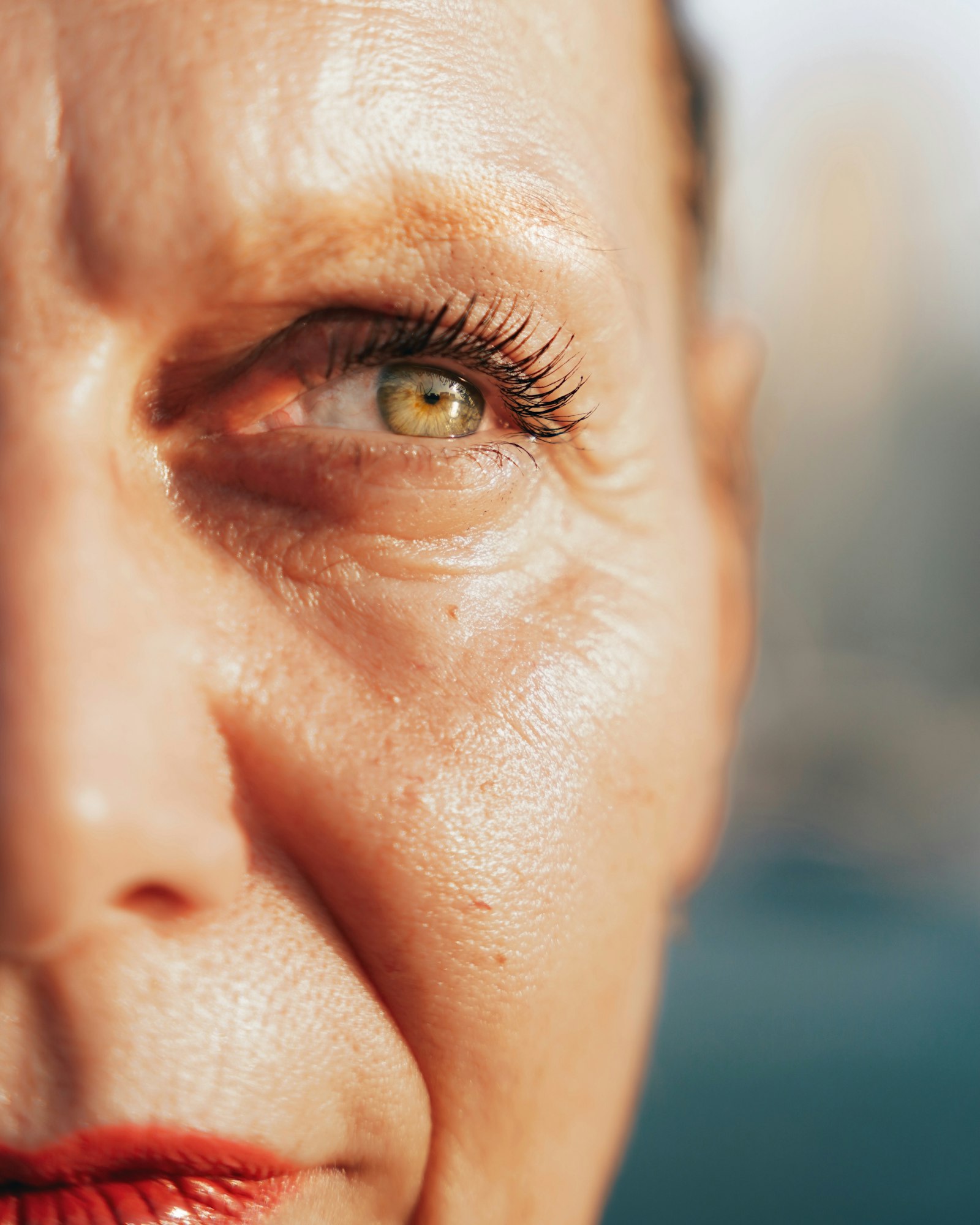
The eye is the smallest area of a face that anybody sets out to photograph, and everything happening up there is measured in millimetres. That's what makes these pairs of pictures so persuasive, and why a good deal of what impresses you in the second may never have involved the eyelid.
Check the eyebrows before you look at the lids
Find a mirror for ten seconds, because this is quicker to prove than to describe. Rest your face, so the brows sit where they sit while you read. Now raise them by the smallest amount you can manage, the way they travel when somebody says your name behind you. Watch the lid: a strip of it appears, the fold clears your lashes, and the eye reads wider. No skin left your eyelid in that moment.
Carry that into any blepharoplasty before and after. Here's the awkward part: nobody has to be arranging anything for it to happen. Brows go up on their own when a lens comes out, and again when the person holding it says open your eyes. And anybody living behind a hood has been lifting them past it for years without ever deciding to, which is not a habit that pauses for a camera.
So a raised brow in the second frame quietly does a share of the operation's work, in the instant the picture is taken. Which gives you your opening question, and the eyelid isn't in it. Do the eyebrows sit at the same height in both pictures?
The forehead usually holds the answer. Only one muscle raises a brow, and it can't work in silence: it gathers the forehead skin upward and leaves a line or two across it. So a smooth forehead in the first frame beside a lined one in the second says the brows were up for the second. Muscle dragging a brow down and skin sitting heavy on a lid look near-identical on a screen and want different treatments, which is why the first has the Botox brow lift to itself.
One more from the same family. A pair of eyes can be open by different amounts in two photographs without anybody deciding it, because the step from an eye at rest to an eye paying attention is a very small one, and small is the only size anything up there comes in. A mild look at the lens in the first frame and a keen one in the second, and some of what separates them is nothing but interest.
What eye makeup does to the very thing being judged
Then the other half of what a face brings with it, and the whole trouble sits in what eye makeup is designed to do. Liner along the lash line makes the lash line show. Mascara raises where the top edge of the eye appears to be. Shadow set above the fold draws a crease where a camera can find one. Every bit of that is aimed at the two things an eyelid operation gives back: a lid you can see, and a lash line that isn't buried under anything.
So a bare-faced first picture and a made-up second make a comparison the cosmetics have already settled, and nothing about that is deliberate; people put makeup on to be photographed. But no camera can separate a lash line that has come back from one that has been drawn, and at your screen, neither can you. Which leaves one rule for the pair, and it applies to both halves of it: no eye makeup in either.
Why a flash can rub out the fold you came to see
A third thing decides what you see, and it isn't the person at all.
Take a coin out of your pocket and try photographing it. There's no ink anywhere on a coin: the head, the lettering, the date are all shape, struck into metal that is a single colour from rim to rim. Fire a flash straight at it and you get a bright disc with almost nothing on it. Set the same coin down beside a lamp instead, so the light comes at it low across the table, and the profile lifts out of the metal — the brow, the nose, the line of the jaw.
Nothing was worn off that coin between the two photographs. The shadow had been doing all the reading, and the flash took the shadow away. Which is also why the flash picture can't tell you what state the coin is in: a head still crisp and a head thumbed half smooth over forty years of pockets come out of a flat-lit photograph as the same bright disc.
An eyelid crease is struck the same way — a fold with no colour of its own, showing only by the shadow it keeps. A flash arrives from the exact direction you're looking from, so the fold has nowhere left to put a shadow, and a hood that is genuinely there can go missing. It runs the other way too: a lamp set low to one side deepens a crease that belongs mostly to the lamp. A pair means something when both frames were lit alike.
The months that usually sit between the two pictures
Then the one thing that isn't in either picture, and it carries more weight than everything that is. How long was the gap?
Anyone who has had a room replastered already knows why it matters. The plasterer leaves, the wall is finished and perfectly sound, and for a while it looks worse than the wall you started with: patchy, pink, no use for judging the room by. Photograph it that week and the picture is all plaster. Come back later and the same wall shows you what was done.
Every operation has a stretch like that behind it, which is why an honest eyelid surgery before and after is usually a pair taken months apart. So a pair with no dates on it is a pair you can only take on trust. Your own settling has no general answer and we won't invent one; it belongs to the surgeon who examines your eyelids, which is where our piece on what the operation removes stops too.
What a fair pair has in it
So picture the pair worth studying. It was taken at one window, at the same hour on both days, from the same distance, with no flash either time and neither face made up, and with both sets of brows resting where they rest. Everything a photograph can contribute on its own has been stripped out of it, and whatever difference survives belongs to the calendar and the eyelids.
Three things then show. The lid platform returns: the strip of skin between the lash line and the crease, which is the part a hood lies down over. The lash line reads from the front again, so the eye has a top edge of its own instead of a fold resting on it. And the eye is open with no help from the forehead — no brows held up, and no lines left across it by holding them.
The fourth gets forgotten, and it outranks the other three. The person still looks like the person: a little less worn, entirely recognisable, not in the least startled. A second photograph that has produced a stranger was aimed at something the operation isn't for.
The startled look, in photographic terms
There's a worry underneath a lot of these searches, and two things get pointed at. One is an upper eye that reads hollow, flat and slightly sunken where fullness sat. The other is an eye that reads as startled: white showing above the iris, and an expression the face around it isn't sharing. That second one is easier to catch on a screen: look at the mouth, then at the eyes, and see whether the two agree.
Behind both of those sits a judgement about how much, and on an eyelid the whole question lives in millimetres. How much can come away while leaving an eye that closes properly and still reads as yours is settled one pair of eyelids at a time, by somebody looking at them. No page can rule on it, and that's why the surgeon looks first.
When the honest answer isn't the operation
Plenty of eyes never need the operation. Where the hood is slight, tightening the skin already there can settle it, without cutting or stitches, which is the ground covered in hooded eyes without surgery, beside the non-surgical eye lift itself. Where the lid skin is fine and the brow has simply travelled down, there is nothing on the lid worth taking away. And where the trouble sits below the eye rather than above it, that's a different complaint with a different answer.
Both routes sit under one roof here, the gentler ones and the surgical suite, so there is nothing for us to gain by nudging you toward either.
Take two of your own, one with the brows up on purpose
The only pair that ever settles anything is your own, and you can have a very useful one of those before you leave the house.
Find the brightest window you have, take any eye makeup off, and hold your phone out in front of you with your face settled and your brows down, eyes open the way they are when you're only looking at something. Take one square on. Then, moving nothing else, lift your brows the way you did at the top of this page, by the smallest amount you can manage, and take a second. Put the two side by side and you have your own face, minutes apart, with nothing whatsoever done to either eyelid, showing you exactly how much of an "after" a pair of eyebrows is able to manufacture. Put today's date on the first one and keep it, because that one is an honest before.
Then bring the eyelids themselves in, because every last thing this page has warned you about is a difficulty photographs have and rooms don't. You describe the thing that's been bothering you, your eyelids are examined properly, and you hear plainly whether an operation or something gentler suits them. Nothing happens until you say so, and surgery here is performed by surgeons at our CQC-registered clinic on Broadway in Manchester.
Arrange your consultation. Bring your two photographs if you took them; by the time you get here you'll have studied a great many other people's eyes, and not one of those pairs had ever seen yours.