You can scroll cheek filler before and afters for an hour and come away no clearer about your own face, and that isn't your fault. In most of those pairs, the light and the height of the camera have more to say about the cheekbone than anything in a syringe does.
The cheekbone in a photograph is mostly shadow
You never really see a cheekbone in a photograph. What reaches you is a bright band where light lands on the front of the bone and a softer dark band beneath it where the light doesn't reach, and your eye puts the two together and calls the result a cheekbone. Take the dark band away and the bone goes with it.
So a cheek photograph is a photograph of a shadow, and a shadow answers to two things: what is casting it, and where the light is standing. A sundial spends all day demonstrating the second of those in a park. At nine in the morning the pointer throws a long shadow across the dial, by one o'clock the shadow is a stub, and by evening it's long again the other way, and the brass never changed length once.
A taller pointer would throw a longer shadow, mind you, and that is exactly what putting height back into a cheekbone does. The difficulty is the sun. It travels further between breakfast and teatime than any pointer will ever grow, so a single photograph gives you no way of telling which of the two you're looking at.
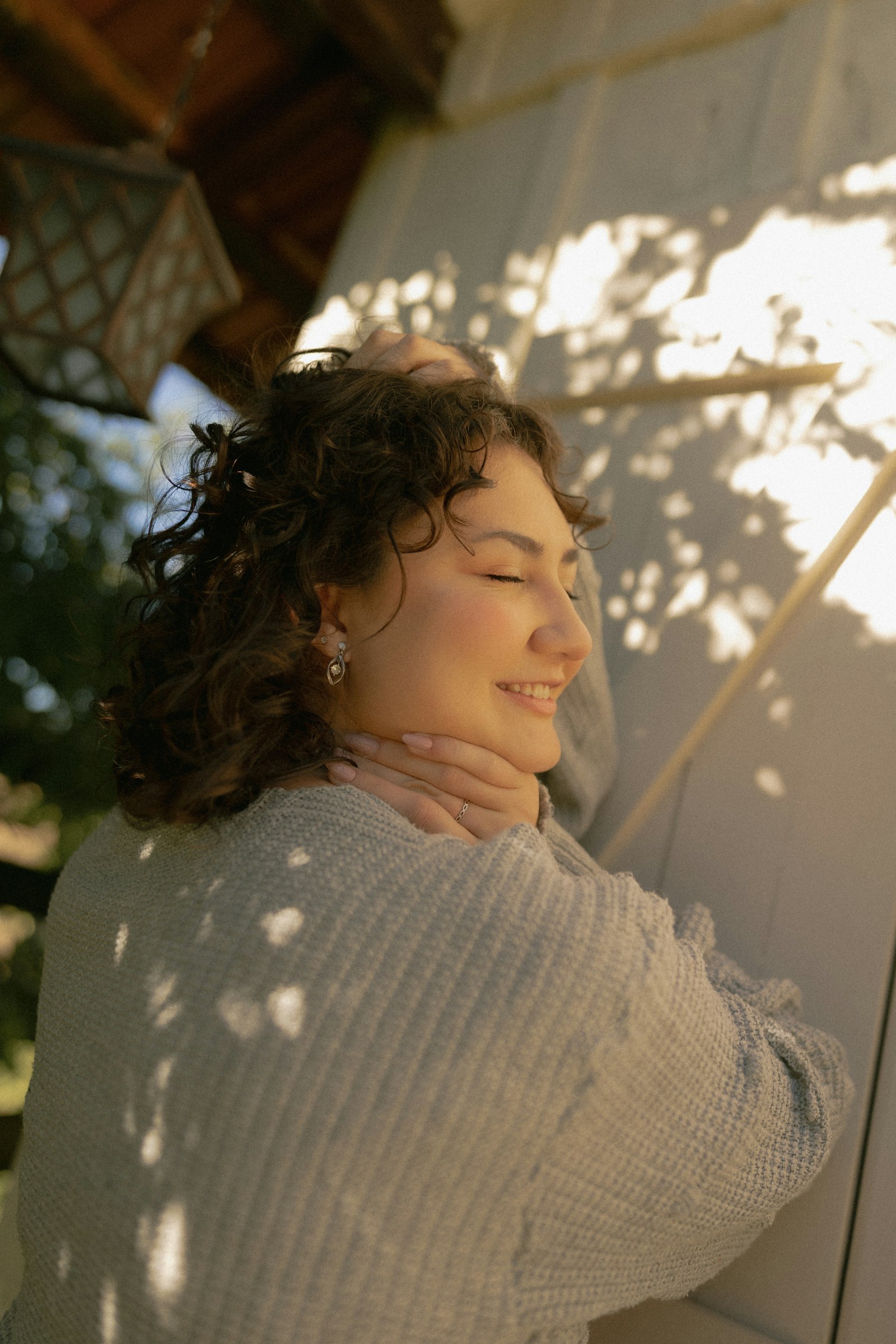
Faces do the same, hour by hour. Light arriving from the side of a room travels across the face, a shadow gathers under the bone, and the mid-face reads sculpted. A ring light sits where the lens is and sends light straight into that hollow, filling it in, so the same face in the same minute reads flat. Dappled afternoon light through leaves lands between the two, which is roughly how daylight treats a face the rest of the time.
Nobody needs to be doing anything clever for that to happen. A ring light exists to flatter, and a treatment room is lit brightly and evenly because bright and even is what you want overhead while somebody works on your face.
So the first question about any pair isn't about the cheek at all. Where is the light coming from in the first picture, and is it coming from the same place in the second? A ring light in one frame and an afternoon window in the other has already handed one of those pictures a cheekbone the other never had, before any treatment gets a mention.
Both pictures have to be taken from the same place
Anybody who has measured out 300ml knows the second problem.
Stand over the jug and the water reads high against the marks. Crouch until your eye is level with the surface and the same water reads lower. Not a drop moved. Which is why every recipe writer tells you to get down to it: a reading means something only if both readings came from the same place.
A cheek reads the same way, and the difference is larger than most people expect. Lift your chin and the cheek turns toward the lens and reads full and high; drop it and the cheek settles toward the jaw. Photograph yourself from above your own eyeline and the cheekbones become the widest thing in the frame; from below, the lower face takes over. So two pictures of the same untreated cheek, taken an afternoon apart, can disagree with each other completely.
So the second question is whether the head sits at the same angle in both frames, and the tell is never the cheek itself. It's the hairline, the eyebrows, and how much forehead the picture has in it. Where one frame shows more forehead than the other, the camera moved too, and no still picture can pull the two apart afterwards.
None of that is unique to cheeks: why good filler work vanishes straight on follows the same problem across the rest of the face.
A smile lifts a cheek all by itself
Smile at your phone now and watch the middle of your face rather than your mouth. The cheek rises, rounds and sits higher on the bone the moment you do it, with nothing placed anywhere. The muscles that pull the corner of your mouth up are anchored on the cheekbone, so a smile gathers the whole middle of the face upward on its way.
So a resting before beside a smiling after is largely a photograph of a smile, and it would look much the same whatever had or hadn't happened in between. Both halves of an honest pair wear the same expression, usually the resting one.
Make-up belongs in the same conversation, and nobody should feel caught out by it. Cream contour under the bone and highlighter above it paint the dark band and the bright band straight onto the skin, which is exactly what they're sold to do. Only a bare face in both frames takes them out of the comparison.
Look under the cheek, not at it
Now the part most people scroll straight past. In a good pair, the cheek is often the least interesting thing in the frame.
Look instead at the crease running from the nose down to the corner of the mouth, and at the jaw. Where height has genuinely gone back into the mid-face, both of those ease, without anything having been placed near them. Why that happens is the whole of why facial ageing starts higher than you think, and it's worth reading before you judge another photograph. It's the same thinking behind the 8-point facelift, which treats the face as one structure rather than one line at a time.
The practical version: read the lower half of both pictures before the cheek gets your attention. Where the cheek is fuller and everything under it sits exactly as it did, you're looking at a fuller cheek, which may be what somebody asked for. A mid-face carried higher shows itself lower down than people expect. And if the jaw is really the part you're weighing up, chin and jawline filler before and after reads that pair rather than this one.
Why a bigger cheek photographs and a restored one doesn't
A photograph taken from the pavement shows you a shop's new sign in a fraction of a second. What it can't show is that somebody spent Sunday putting the shelves into an order that finally makes sense, because the only way to discover that is to walk in and come straight out again with the thing you went in for.
Cheeks divide along the same line. A cheek made larger is a sign. It reads instantly, at any distance, in any photograph at all, and reading instantly is the whole of what a sign is for. That's the look nearly everybody arrives worried about, and it fills so many screens for a reason that has nothing to do with how often it happens: a still frame is the one place it shows at its best.
A cheek put back where it used to be is shelving, and shelving photographs like nothing much at all. Nothing new has arrived in the frame. Something that had gone is simply where it was before, and a photograph has no way whatever of showing you a return. Try getting a phone to prove that.
So the quiet pairs are the hard ones to read, and a pair that makes you gasp on a small screen is often one where something was made larger rather than put back. A subtle result photographing weakly is a fact about photography rather than about the result.
Where to stand, and what to keep in the frame
All of which is cheerful rather than discouraging. The pair that would settle it for your own face is one nobody has taken, and you can take half of it this evening.
It's two minutes' work. Stand where the light crosses your face rather than arriving straight at it, and note the room and the hour, because you'll want to stand there again. Chin level, mouth resting, skin bare, phone level with your own eyes. Take one frame square on and one with your face turned toward the light, and keep the crease beside your nose and your jawline inside both, since those are the two places an answer would show. Then write the date on it.
The rest of the answer comes from the appointment, which does what no photograph can. We look at where your face has lost height, say what restoring it would do for the thing bothering you, and what it would leave untouched. We use Juvéderm® dermal fillers, a hyaluronic acid gel your body breaks down again in its own time, and treatment takes around thirty minutes. Every injectable at Broadway Retreat is delivered by experienced medical professionals at our CQC-registered clinic on Broadway in Manchester, and nothing goes ahead until you've decided. What actually happens at a consultation sets out the visit itself.
Arrange your consultation and describe what's been bothering you in whatever words you've got for it. Every cheekbone you've been holding yourself against was photographed in somebody else's light, from somebody else's angle, on somebody else's face. Yours is the one we can look at properly, in a room, with the light where it is.