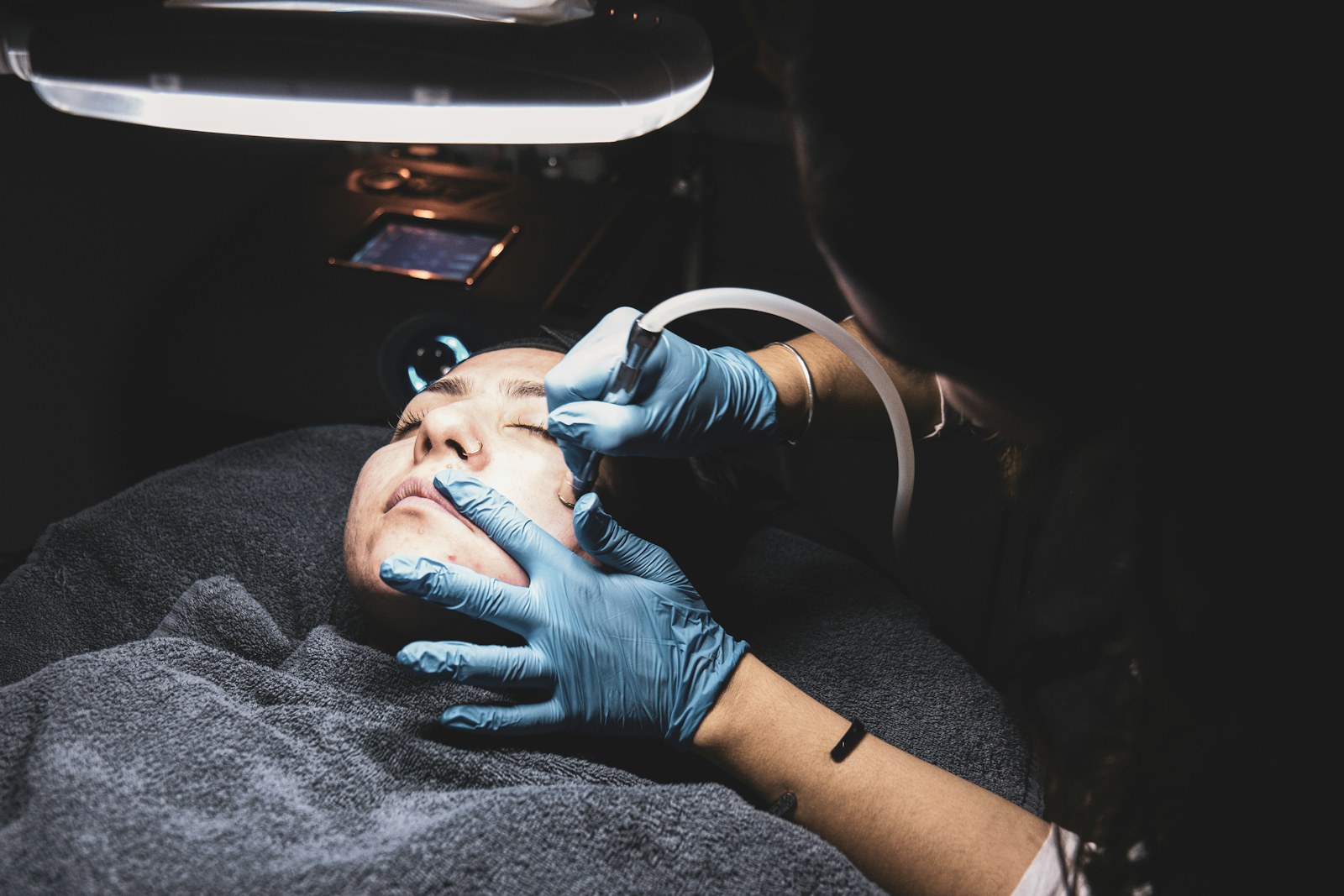
You'll leave a microneedling appointment looking as though you've caught the sun, and most people spend that first evening quietly wondering whether it's supposed to look like that. It is, and that colour is the only part of the whole treatment you get to watch happening.
What the first evening after microneedling actually looks like
Straight afterwards your face is warm, a little tight and flushed, much as it is after moderate sun. The colour is at its strongest right at the start and eases from there rather than building: it settles within a couple of hours, and your skin is back to normal within a day or two.
How much colour you show depends on your skin, on the area we treated and on the depth we worked at. One person is faintly pink by teatime; another still has some warmth about the face that evening, which is what the day or two is for.
There's very little to do that evening, which catches people out more than the redness does. Keep the room cool, leave your face alone, and put on only what we've told you to put on.
Why the redness is the repair getting under way
Here's the bit that changes how everything below it reads.
Red skin, by itself, tells you that blood has arrived at the surface. It doesn't tell you what called it there. You know that already from blushing: the same colour, arriving at the same speed, on a face with nothing whatsoever the matter with it.
After microneedling, what called the blood is something we did on purpose. The treatment makes thousands of microscopic columns in your skin, controlled and set to a depth. Break the surface of skin, even that finely, and repair begins — and blood is how repair gets supplied. So the flush is the supply turning up exactly where we asked for it.
Plenty of people reach that first evening braced for something to have gone wrong. You're looking at the start of the work rather than the cost of it, and more colour doesn't mean more result.
The tight, dry, flaky days after microneedling
Then the colour goes, a different feeling takes its place, and this is the stage people are least prepared for: skin that feels tight, and drier than usual.
The reason is simple. The surface of your skin is a seal, and much of its job is keeping your own water in. While that surface is being rebuilt it holds less well than it normally would, and skin losing water faster than usual feels tight and looks dry.
Think of a room with the window open. Nothing about the room needs mending; the warmth is simply leaving faster than it arrives, so the room feels cold. You wouldn't start pulling the walls apart over that. You'd hang something across the window and let the room warm back up, which is exactly the job a moisturiser does here: it doesn't do any of the repairing, it just slows what's leaving while the repairing happens.
Some people get a fine flakiness with it, like the last of a light tan going, and some get none at all. Either way, leave them to it: those flakes are the old surface coming away on a schedule of its own, and scrubbing or picking at them takes some of the new surface along with them.
When you can wear make-up again
We'll tell you which day at your appointment, because the answer follows what we actually did: a light session and a deeper one aren't the same skin the next morning. What's useful in advance is why there's a wait at all. Make-up sits on and in the surface of your skin, which is the surface currently rebuilding itself, and everything that goes on has to come off again, which means more cleansing and more rubbing than these days want.
Why sun protection matters most in the days afterwards
Of everything on your aftercare list, sun is the one we'd ask you to take most seriously, and there are two reasons for it rather than one.
The first is that skin in the middle of repairing catches the sun more easily than it usually does. Its ordinary defences aren't back up yet, so an hour that would normally be nothing can mark it.
The second tends to land harder. You have just asked your skin to build new collagen, and sunlight is one of the main things that breaks collagen down across a lifetime, which is exactly why sun-damaged skin sits on the list of what this treatment is for. So strong sun in the days afterwards has you asking your skin to build collagen while handing it the thing that takes collagen apart.
So it's shade first, then sunscreen on anything the sun can reach, and we'll tell you when to start yours rather than leave you guessing. Bright winter days count too, and so does a holiday booked for a fortnight's time: say so at your consultation and we'll place your appointments around it.
Three things to skip, and why they aren't the same rule
Three things come off the menu for the days just afterwards, and they're on that list for genuinely different reasons.
Retinol and exfoliating acids work by asking your skin to shed and renew faster than it would on its own, which is precisely what makes them good products. Your skin is already doing that without being asked, so adding the instruction on top tends to show up as soreness rather than as a better result. They go back on after however many days we tell you.
Fresh gym sweat is a different objection altogether. Sweat is salty, and it lands on skin that stings more easily than usual. A hard session also brings heat and blood back up into your face, and the flush comes with it. That's a few days rather than a ban on exercise, with a gentle rinse afterwards once you're back to it.
Pools, saunas, steam rooms and hot tubs raise both objections at once: chlorinated and shared warm water aren't what freshly treated skin wants, and the heat does to your face what a hard session does.
If you're having other things done with us, the rules don't carry across. Anti-wrinkle injections ask something completely different of you afterwards, and for completely different reasons.
Microneedling downtime and recovery time: two different questions
"Downtime" gets used for two separate things, and pulling them apart answers what most people are really asking.
There's what your skin needs, which is the couple of hours for the flush to settle and the day or two to be back to normal. Then there's the part nobody puts into those words: how long until you'd be happy to stand under a bright kitchen light at somebody's birthday.
Most people find they're presentable the next day and back to everything within a few days. That's what's typical rather than what's promised, and how it runs for you depends on your own skin and on the session you had.
The diary is the part worth planning, and it's easier than people fear. If there's a date you'd hate to be pink for, tell us and leave more room than you think you need, because we can plan around a diary far more easily than we can hurry your skin.
Most people have a course of these rather than one appointment, so it's a few quiet evenings spread across a few months. What you're waiting for arrives long after the redness has gone. Visible improvement typically begins around six weeks and carries on over the months that follow, which is why the photograph worth having is the one taken before you start rather than the one from the next morning.
If it doesn't look like what we described
Whatever we say to you in the room outranks this page. You'll hear it before you leave, and it's said about your skin, your area and the depth we actually worked at.
So if something in the days afterwards doesn't match what we described, ring us on 0161 526 2232 and tell us what you're seeing. Whoever treated you knows the depth we used and the area we covered, so the answer usually takes a minute.
Come and see where this would fit in your week
If it's the days afterwards holding you back rather than the treatment itself, that's an easy thing to settle. Arrange your consultation at our clinic on Broadway in Manchester, tell us what your week looks like, and we'll be straight about how this would sit in it and whether it's the right treatment for what you want changed. If acne scarring is what brought you here, say so when you book and we'll set aside the time to go through it.
Every treatment at Broadway Retreat is delivered by experienced medical professionals at our CQC-registered clinic, and nothing goes ahead until you've decided. The microneedling treatment page covers the treatment itself if you'd rather start there.
The redness is the short part. What you actually booked for goes on being built underneath it for months afterwards.