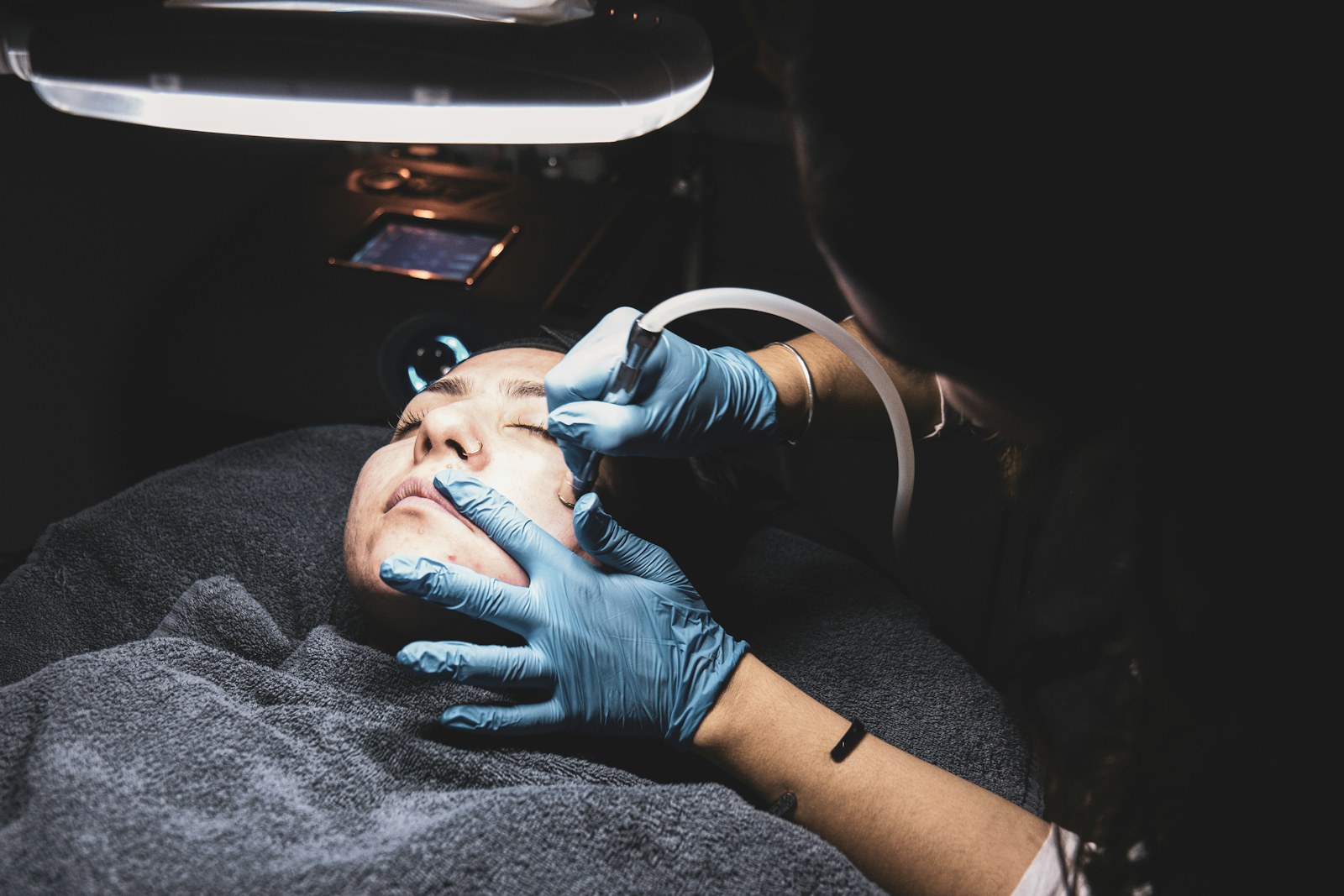
There's one treatment where the explanation sounds like a mistake: to improve your skin, we make thousands of tiny holes in it. Stay with us for a paragraph, because the reason that works is the same reason a hard week of training leaves you stronger than it found you.
What microneedling actually does to your skin
Our microneedling treatment uses a device called EDS Regenerate, and what it does is simple enough to picture. It creates thousands of microscopic columns in the skin, far finer than anything you could see, placed evenly across the area being treated.
Then it stops, and your skin takes over. That really is the whole trick, because microneedling works with your skin rather than on it. New collagen forms, new cells generate, and the structure of the dermis strengthens.
Two of those words are worth translating before we go any further. Collagen is the protein that keeps skin firm, and you make less of it as the years pass, which is a large part of why skin loosens and lines settle in. The dermis is the layer sitting underneath the surface you can see, and it's where all the structure lives. So when we say the dermis strengthens, we mean the scaffolding under your skin gets rebuilt, and the surface you actually look at ends up sitting on something better than it was.
Why your skin repairs past where it started
Now, the reason any of that makes sense is a fact about your own body rather than about the treatment.
Your body doesn't repair damage back to exactly what was there before. It repairs with a margin. You already know this from your own muscles: training works by causing tiny amounts of damage to the muscle fibres, and your body rebuilds them a little stronger than they were, because rebuilding them to exactly the old strength would only leave you facing the same load with the same weakness next week. Repair, in a living body, means preparing as well as patching.
Your skin does the same thing. A repair call goes out from those thousands of tiny columns, the cells that make collagen answer it, and they lay down new collagen right through the treated area. Nothing arrived from outside. Your skin simply did what it always does when something needs mending, except this time it did it across a whole area at once rather than in one small spot.
There's one word that has to be true of the damage, though, and that word is controlled. A training session and an injury both count as damage to a muscle, and only one of them is chosen, measured, and something you'd happily do again. Microneedling is the controlled kind. The depth is set, the columns are microscopic, and the aim is to ask for the repair rather than to do harm that needs undoing.
What microneedling genuinely improves
All of that happens underneath, which tells you a great deal about what microneedling is good at. The concerns that improve most are the ones that come down to structure, and to the quality of the surface sitting on it.
Uneven texture is the clearest example. When skin isn't smooth, light catches it unevenly, and that's usually what you're seeing when your skin looks rough or tired in the mirror even though the colour is perfectly fine. Rebuild the support underneath and the surface evens out along with it.
Acne scars respond particularly well, and there's a satisfying logic to why. An acne scar is a small dent where the skin healed short of the level around it, so what it needs is exactly what microneedling asks for: more building, in that spot. Professional skin-needling is clinically established, and acne scarring is one of the concerns it improves most significantly. There's far more to say about that than fits here, so if scarring is your main reason for reading, our piece on microneedling for acne scars goes properly into which kinds improve most and which improve least.
Ageing skin and sun-damaged skin are the other big ones, along with the fine lines that settle on the face and on the décolleté, which is the chest and neckline. That area earns its own mention, because it spends a lifetime in the same sunlight as your face while getting almost none of the same care, and it tends to age a step ahead of everything above it as a result.
Stretch marks respond too, for much the same reason. They appear when skin is stretched faster than it can adapt, in pregnancy, in adolescence, with changes in weight. The collagen tears as the skin gives way, so a stretch mark is another place where the structure underneath never finished rebuilding, and treatment can significantly improve how they look.
And then there's the brightness, which tends to be the first thing people mention when they're pleased. That comes from the new cells generating across the treated area. The honest summary of a good result is smoother, brighter, healthier-looking skin, produced by your skin itself.
Is microneedling a facial?
In the everyday sense it's a fair description, and we'd never quibble with anyone who calls it one: you book an appointment, you lie back, and it's done to your face.
The difference worth knowing is where the work happens. A traditional facial does its good work on the surface, lifting away the dead cells that hold the dullness, and microdermabrasion is our version of that: thirty painless minutes, no downtime at all, and you leave visibly fresher. That's the one to ask about if what bothers you is dullness, clogged pores or light sun damage sitting on the surface.
Microneedling is aimed underneath, so its result takes longer to arrive and comes from a different place entirely. Which of the two your skin wants is one of the easier things to settle in person, and plenty of people end up having both at different points in the year.
What the appointment is like, and when you'll see a change
The consultation always comes first, because we need to confirm the treatment suits your skin and the change you're hoping for. Then the treatment itself, where the EDS device passes over the skin and creates those thousands of controlled micro-columns.
Straight afterwards, your skin looks and feels as though it has caught moderate sun: warm, a little tight, slightly flushed. That settles within a couple of hours, and your skin is back to normal within a day or two, which is why this one fits into an ordinary week far more easily than people expect.
The timing of the result is the thing to know before you book, because it catches people out otherwise. You won't walk out transformed. Visible improvement typically begins around six weeks, and carries on developing over the months that follow.
There's a good reason for that wait, and it's simply how collagen works. Your body builds it at its own pace, so something built over weeks arrives over weeks. The upside is rather lovely: the change turns up gradually enough that nobody can point at the day it happened, and it keeps arriving long after you've gone home.
How many appointments your skin needs belongs to that first consultation too, because it follows from what we find when we look rather than from anything anyone could sensibly tell you beforehand.
What microneedling won't do
This is the part we'd rather you read twice, because knowing what a treatment can't reach is what stops you booking the wrong one.
It won't add volume. A hollow that sits there while your face is completely still, a flattened cheek or a groove under the eye, is a place where volume has gone, and putting volume back is the job of dermal fillers. Building collagen improves the material your skin is made of, which is a different job entirely from replacing what has gone from underneath it.
It won't lift, either. Better skin is still skin in the same position, so if what has changed is the position itself, a jawline that has softened its edge or a cheek that now sits lower on your face, that's a lifting question, and it belongs with a thread lift or with surgery.
It also won't relax a muscle. Lines that mostly appear when you move, when you frown or raise your brows or smile, are made by the small facial muscles creasing the skin, and anti-wrinkle injections are what those call for. Muscle lines and skin quality are easy to mix up, so if you're not certain which of the two you've been looking at, our piece on Botox and fillers is the one to read next.
On scars, we'd rather be plain with you than optimistic. It may not be possible to remove a scar completely. What treatment can do is make it significantly less visible and less prominent, and we'll tell you at your consultation exactly what to expect for yours. Scars come from all sorts of places, which is why we match the method to the individual scar rather than putting every scar through the same one.
Who tends to love microneedling
After enough consultations, the same few descriptions start coming round again.
People whose complaint is the quality of their skin rather than the shape of their face. They're happy with how they look, and they'd just like the surface to be smoother and brighter than it has been lately.
People with acne scarring, especially the ones who spent years treating the acne itself and never got round to the marks it left behind.
People whose chest and neckline have started ageing ahead of their face, which happens to almost everyone eventually and to sun-lovers sooner.
And people who can't take real time off. Being back to normal within a day or two is a genuine advantage when your diary has no room for a recovery.
One more, and it might be the best reason of all: people who simply like that the result is made by their own body. If that sounds like you, you'd probably get on well with platelet-rich plasma too, which comes at the same idea from another direction by using your own platelets to call your collagen-producing cells into action.
Come and ask what your skin would do with it
If the texture of your skin has been quietly bothering you, or there are marks you'd long since given up on, bring them to a consultation. We'll look properly, tell you honestly whether microneedling is what your skin is asking for, and say so just as plainly if something else would serve you better.
Every treatment at Broadway Retreat is delivered by experienced medical professionals at our CQC-registered clinic in Manchester, and nothing goes ahead until you've decided. The microneedling treatment page has the fuller picture if you'd like to read that first.
Most treatments hand your skin a result. This one asks it a question, and your skin spends the next few months answering.