A good many people carry a small thing that has caught on the same collar, the same necklace or the same towel for years, and has never once been mentioned to anybody. That silence is the interesting part, because it is very often the only reason the thing is still there.
What a mole is, and what a skin tag is
Two things get filed together in most people's heads, under something like small bits on my skin, and they aren't remotely the same. Separating them is the most useful thing this page can do for you, so let's do it with a floorboard.
Wood has grain running all the way through it, and here and there a knot, which is simply the place where the tree once put out a branch. Nobody kneels down, finds a knot in a floorboard and concludes that something has gone wrong with the plank. It's where the wood did something different in one spot, it's part of what makes that board that particular board, and it was there long before the board was a board.
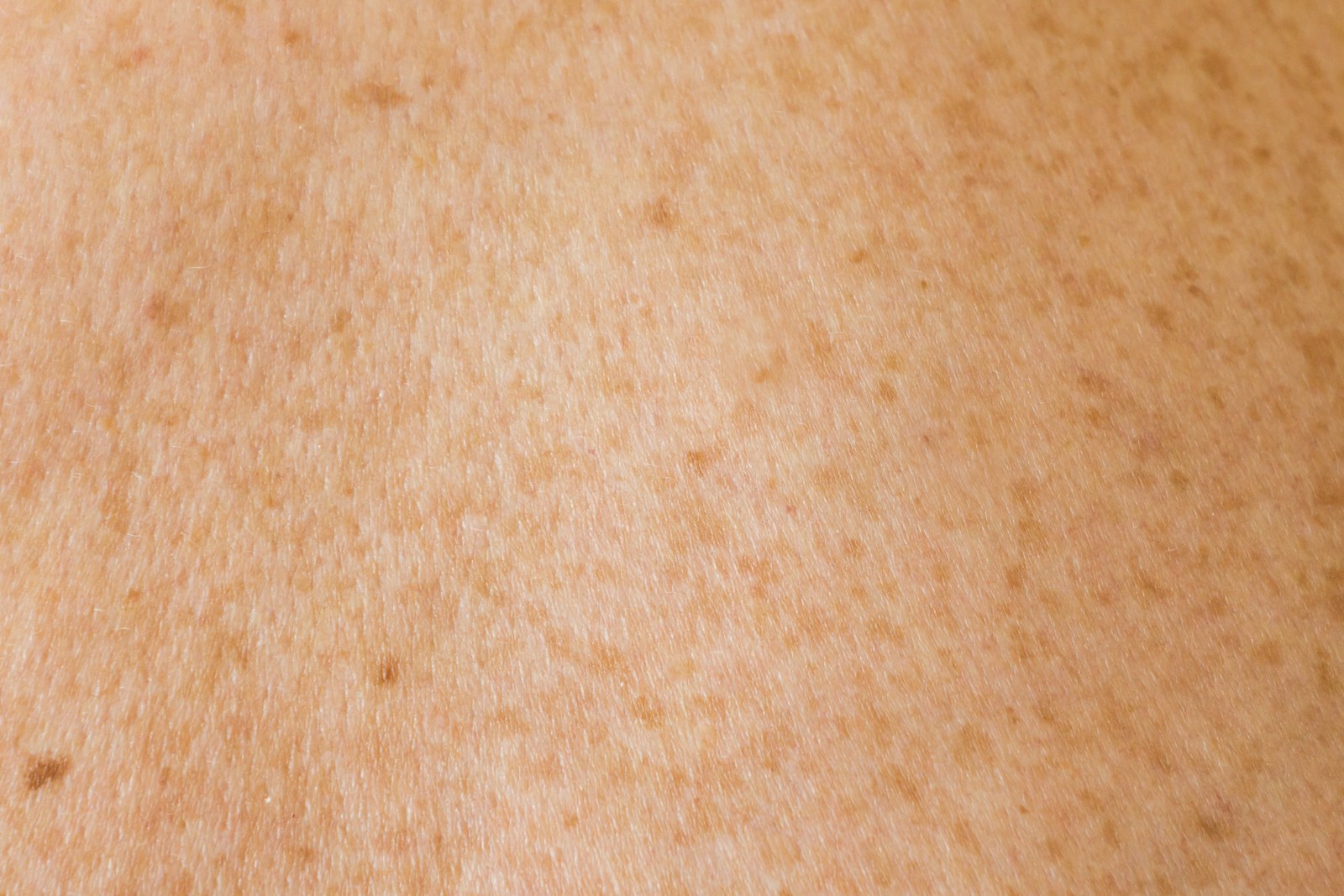
A mole is the knot. Your skin gets its colour from cells spread evenly all through it, and a mole is a small group of those cells growing close together in one place instead of spread out. That really is the whole of it. Almost everybody has them, most people have a fair number, and having moles is the ordinary condition of a human being rather than an exception to it.
Now the other thing on that same floor, and it's a completely different animal: the one nail head that has worked its way slightly proud of the board. It is tiny. It has done no harm whatsoever to the floor. And it catches your sock every single time you walk past it, which is something you notice roughly a hundred times a year.
A skin tag is that nail head. It's a small, soft growth of skin, usually sitting on a little stalk of its own, and it tends to turn up where skin folds or rubs: the neck, the underarms, the eyelids, under a collar or a strap. Skin tags are harmless. They are also very hard to ignore, and those are two very different facts about the same small thing.
So one of them sits in the grain and the other sits proud of it. Hold on to that, because it's why they come off so differently, and why they're two separate conversations once you're sitting in front of somebody.
Why people have them removed, and why your reason counts
Here's the part worth saying early, because it is very easy to arrive feeling you ought to apologise for asking at all.
The commonest reason has nothing to do with how anything looks. Skin tags catch. On clothing, on jewellery, on towels, on the razor every morning if one has set up somewhere along a jawline. They annoy far beyond their size, and there is no relationship at all between how big a thing is and how much of your day it quietly takes up.
Which is the nail head again, and this is the bit that matters. Nobody calls in a joiner over one raised nail, so it stays raised for a decade, seeing off a pair of socks a month. Small things get put up with precisely because they're small. The thought runs: it's hardly worth mentioning, so I won't mention it. And then that same thought turns up once a week for ten years, and the thing is still exactly where it was.
Then there are the reasons that are simply about you. A mole sitting somewhere you'd rather it didn't. One that turns up in every photograph you've ever been in. One your razor finds, or your collar finds, or your own fingers find without you ever meaning them to. If a mole concerns you, or its position affects your confidence, that is a reason and it is a whole one. It doesn't need justifying to anybody, ourselves very much included.
The same goes for a skin tag. Removal is quick, and afterwards it simply stops being part of your day. That is a perfectly good thing to want.
Why nothing comes off until somebody has looked
This is what separates a clinic from a chemist's shelf, and it's worth understanding rather than just being told.
The right way to deal with an unwanted mole starts with an assessment, not a removal. We examine the mole first, and what we find decides everything after it, including how the mole comes off. That order isn't ceremony. It's the only order in which anybody can answer your questions about your own skin, because until somebody has looked, every answer available is a general one and yours is a particular mole.
There's one thing we'd rather you didn't sit on, and it's a gentle point: if a mole of yours has changed, that's one to have a doctor look at soon rather than whenever you next happen to think of it. Everything else on this page can wait quite happily for a convenient Tuesday.
With skin tags, the looking does a slightly different job. There's no shortage of off-the-shelf remedies for taking skin tags off at home, and we would always recommend medical advice first. Partly for the peace of mind that what you think is a skin tag actually is one, which is not something anybody can settle from their own bathroom mirror. And partly for a plainer reason than that: professional removal gives the cleanest, least visible result, and it is your neck.
It helps to know who does this sort of work, too. Because Broadway Retreat is a CQC-registered clinic on Broadway in Manchester, our surgeons can perform a range of minor surgical procedures alongside everything non-surgical we do. Mole removal and skin tag removal are both on that list. They're short operations that resolve something that has bothered you for years, and that is a fair description of the whole business.
What mole removal actually involves
Once the mole has been assessed, the method follows from the mole itself. Its shape and its size are what decide the right method, which is exactly why we'll talk you through the options at your consultation instead of naming one on a web page. The mole is then removed safely, with minimal disruption to your day.
Then comes the part people tend to be gladdest to hear about, and it's the reason mole removal is a slightly larger idea than simply taking something off. Afterwards, we can arrange histology. That word only means the removed mole is sent away for testing, and what comes back tells you more about its nature than looking at it from the outside ever could.
It's worth pausing on what that gives you, because it's the whole point of doing it in that order. The mole is gone, which is what you came in for. And you are told what it actually was, which is something most people never get to know about their own skin. That's the peace of mind, and it is a genuinely useful thing to be handed.
What skin tag removal actually involves
This one is shorter, and pleasingly so.
First we confirm that it is a skin tag. Then we choose the removal method its shape, size and position call for, because we offer several and they aren't interchangeable: a tag on an eyelid and a tag under a strap are not asking for the same thing.
Then it's done. Skin tag removal is straightforward, painless, and usually complete within thirty minutes.
That last sentence is the one people read twice. Something you have carried around for years, worked around, planned outfits around and apologised to towels for, fits inside half an hour on an ordinary afternoon. It's a strange bit of arithmetic, and it catches very nearly everybody out.
The questions this page can't answer
Now the bit where we stop, because there's a line between explaining what a treatment is and pretending to have examined you.
You will find pages that tell you exactly how your removal would go, precisely what your skin would do afterwards, and what you would be left looking at. We won't, and the reason is a simple one. None of those questions has a general answer. The real answer is always about one particular mole on one particular person, and yours hasn't been looked at yet, so anything written here about your result would really be a description of somebody else's.
What can honestly be said from a page is short. The assessment comes first. The method follows from what is actually there. Histology can be arranged once a mole has been removed. And every other question you have, the practical ones about afterwards included, belongs to the consultation, where somebody can look at your skin while they answer it. If it's the appointment itself that's putting you off, what actually happens at a consultation takes the mystery out of a first visit, and a mole you'd rather not have is squarely on the list of things people bring us.
Come and have it looked at
If you've spent any part of this article with a hand at your neck, or on the exact spot you always find without looking, that's your answer about whether to ask. Arrange your consultation and bring the thing itself with you. We'll look at it properly, tell you which of the two you've actually got, and explain plainly what removing it would involve for you.
Every treatment at Broadway Retreat is delivered by medical professionals at our CQC-registered clinic in Manchester, and nothing goes ahead until you have decided.
And the floorboard? Somebody taps that nail flat in about four seconds, and then you spend a fortnight noticing that your sock doesn't catch. A skin tag takes a little longer than four seconds and a great deal less than an afternoon, and the fortnight afterwards is exactly the same. Small things are like that, which is the whole reason they're worth mentioning.